

Patrick Bateman Made Me Realize I Can’t Read
How American Psycho Became the Ultimate Test for My Internet-Fried Brain

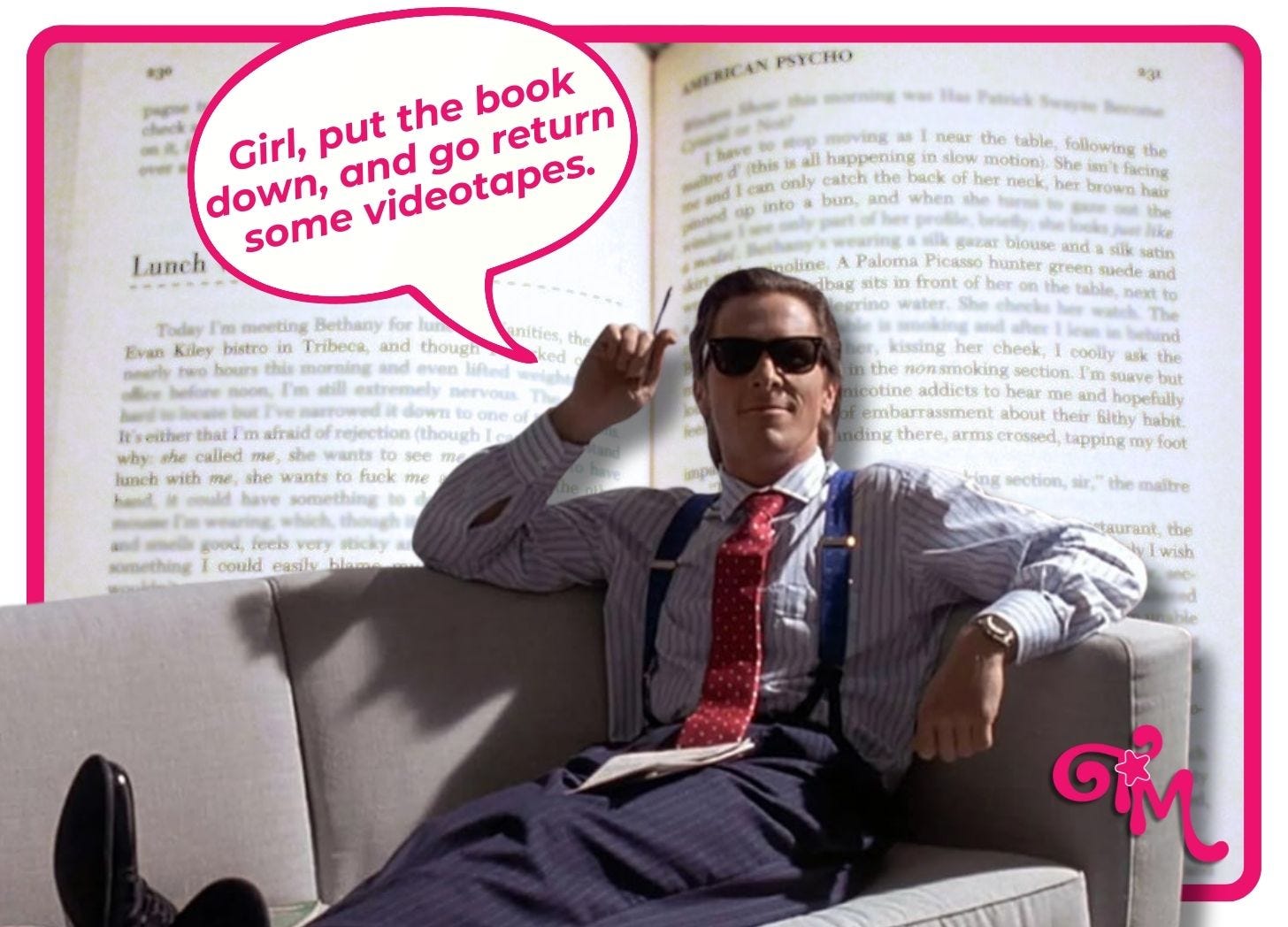
I am on my lunch break. An angry client yelled at me this morning. My coffee failed to do its job. And it’s raining. I desperately need a sweet release. Something to take me out of the monotony of an unending Tuesday in early spring. Or is it late winter? Recently, for some reason, I have been trying to find that release in Patrick Bateman.
My book of the month is American Psycho by Bret Easton Ellis. Ellis is an author/screenwriter who labels himself a “satirist.” His writing style places a “neutral gaze” on explicit and “extreme acts”. Nonchalant sadism and narcissism (sounds like all my options on Hinge). His characters are cold, cruel, and shallow, yet you can’t look away. He thrives in that sweet spot between satire and outright depravity, making readers wonder if they should be laughing, horrified, or both. Fun fact! Both he and Donna Tartt (author of The Secret History) graduated from the same private liberal arts school, Bennington College... What in the world were they teaching over there? Was “Becoming a Literary Menace” part of the curriculum? 1
American Psycho is a commentary on the shallowness of consumerism and capitalism told through the lens of investment banker/serial killer, Patrick Bateman. We follow Bateman as he goes about his daily life in 1980s New York City and watch as he plummets into madness. The book reads like a Wall Street bro’s fever dream—hyper-detailed descriptions of designer suits, restaurant reservations, and skincare routines, all spliced between bursts of violence. The line between reality and hallucination blurs so much that even Bateman himself seems unsure whether he’s actually committing his crimes or just imagining them between his morning workout sessions and business card critiques.
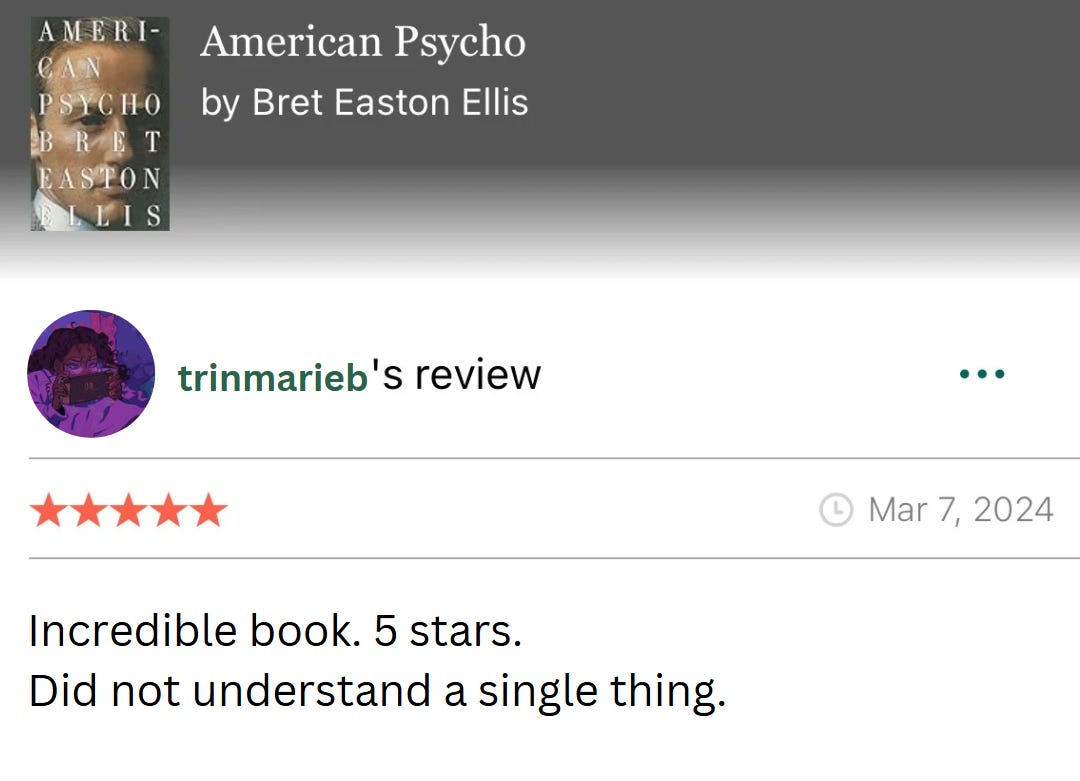
I have yet to finish the book. I am a slow reader, but it is taking longer than expected. I planned on getting to the end and then writing a full review, but I came across a problem that I needed to make known immediately. During my trek through the first 150 pages, Ellis and Patrick alike have unearthed an infuriating realization. A gripe I’ve discovered with the work. I can’t read it. Maybe the correct thing to say is that I cannot understand what is going on. Now, this is quite the confession for me to make. I am a proud critical thinker. A comprehensive reader. I was in the third grade, reading and understanding stories like The Odyssey and Beowulf (OMG you were so well-read. Should we throw a party? Should we invite Homer?). But for some reason, I only get more confused each time I pick up Ellis’s book.
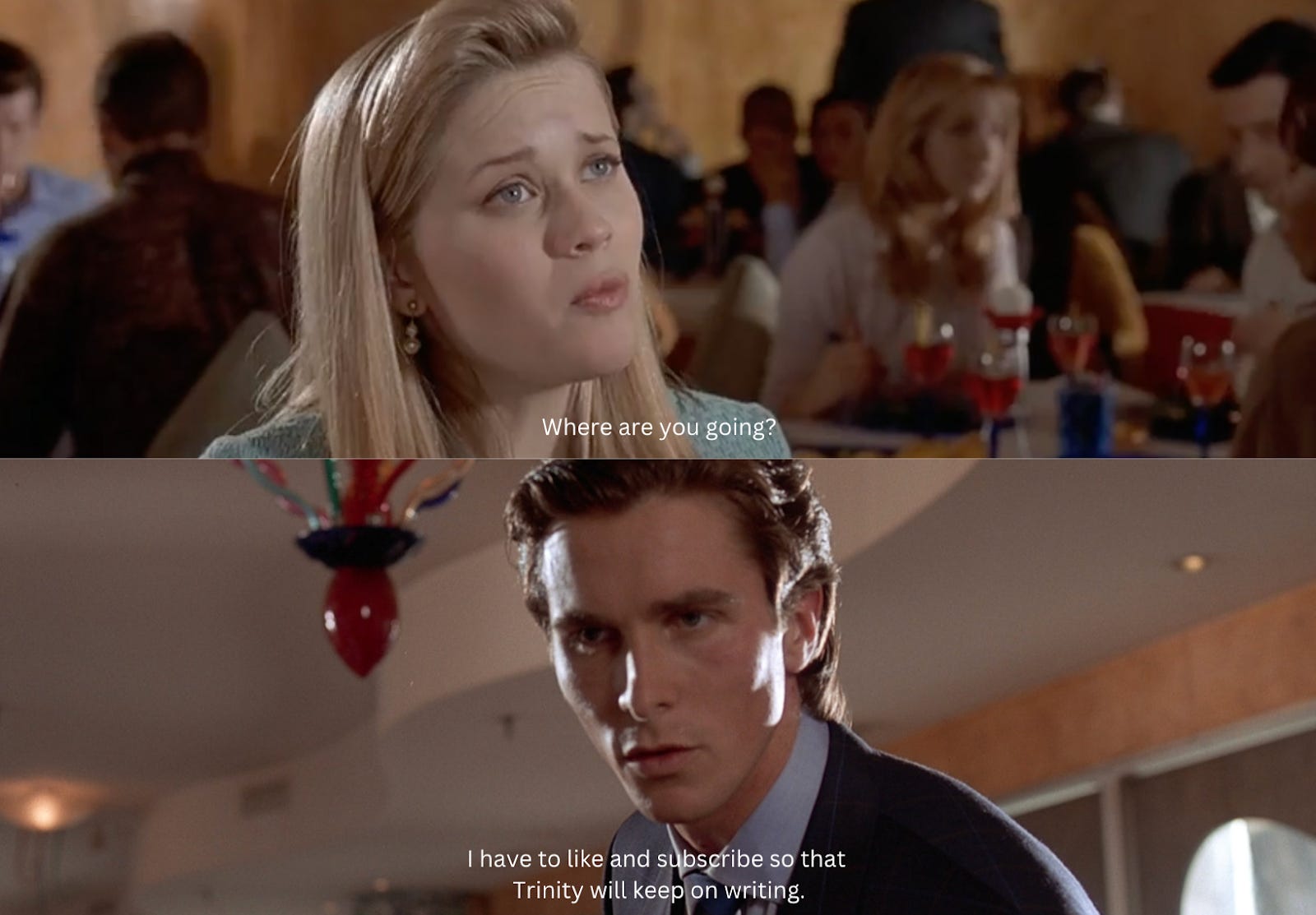
I find myself rereading each page, pausing, and trying to explain to myself what I just read. Breaking down each thought as if I had a companion study guide open. I cannot comprehend the material in front of me, and it has not been the sweet release from my customer-facing work that I was looking for! I am frustrated and confused, and I have no idea if Patrick just told his girlfriend he wanted to chop her body into hundreds of pieces or not. I do, however, have an idea of what the problem may be. What’s stopping me from breezing through a book 14-year-old Trinity would read in a weekend?
It’s all the unthinkable amount of time I spend on the internet. The current social media landscape favors content that provides instant gratification. It’s quick, it’s easy, and it’s causing problems in other parts of my life. Short-form content has ruined my ability to read, and I only realized this because of whatever the hell is going on (or isn’t going on?) with Patrick Bateman.
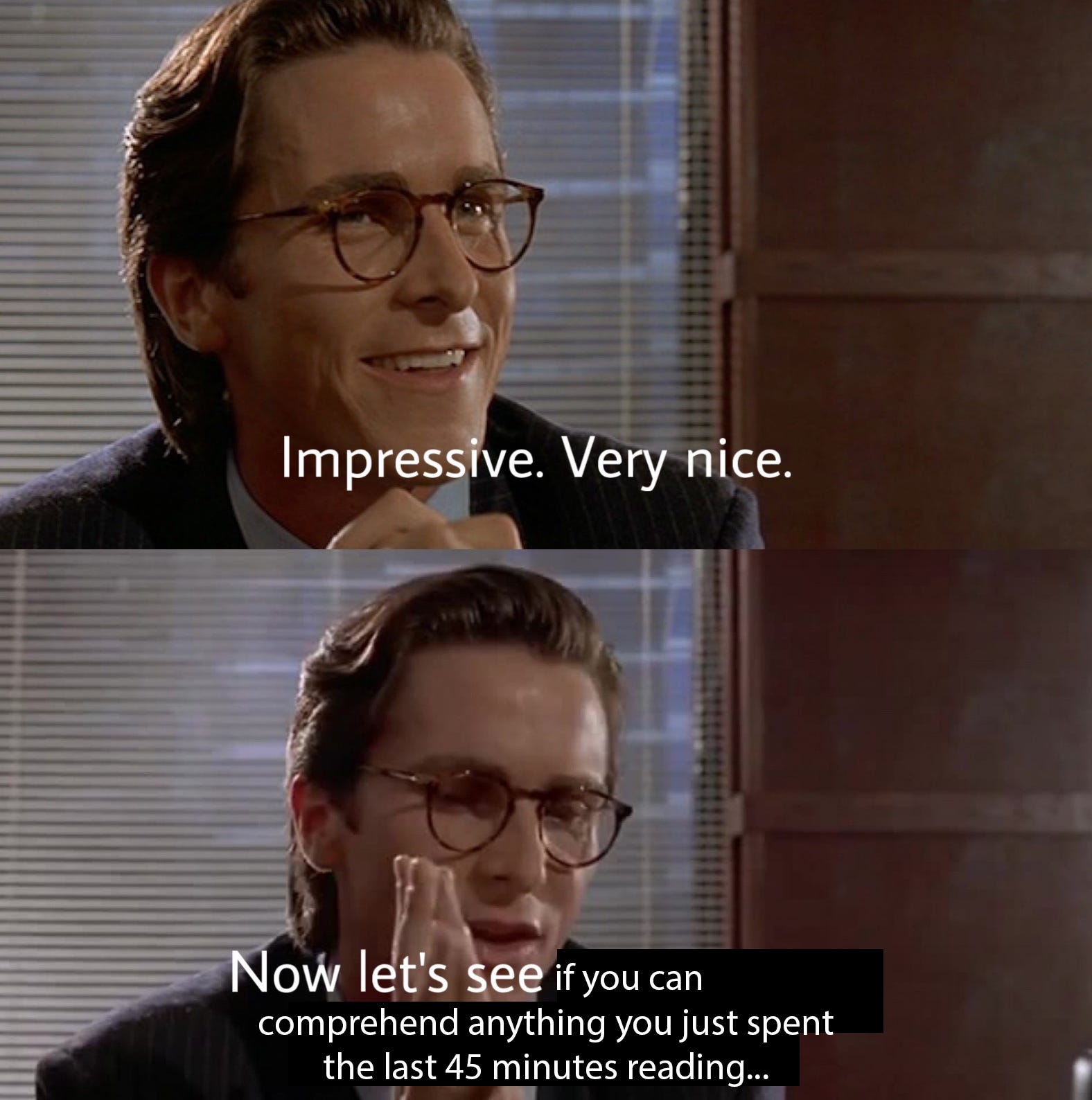
I won’t attribute my inability to comprehend a 400-page book solely to my internet usage. Ellis will receive some of the blame here. It is a difficult book to read. Both the style of writing and the content are advanced and are not meant to be easily processed. Ellis possesses one of my favorite but excruciating writing styles: the extreme detail of the mundane.2 He spends paragraphs describing the outfits everyone is wearing. Dropping names of designers, colors, patterns, fabrics, etc. This happens in basically every new setting Patrick enters. Bateman and colleagues will go out to dinner, and we get a full play-by-play of what everyone has ordered. Drinks, appetizers, main courses, desserts. Pages are spent describing a band’s discography. Listing feelings evoked from their songs. Messages they included. A whole section was spent on Bateman Christmas shopping for friends and colleagues.
You want to be able to comprehend what is being described fully. To create a clear picture in your head of what Ellis is writing. To be right there with them. But if you don’t know the designer or the pattern, the song, or the department store, it is hard to get the full picture. And the thoughts are being thrown at you, one right after another. It is hard to keep up. I have to stop. Reread. And still, I don’t fully grasp the descriptions. David Van Patten jumps into the conversation, and I cannot remember what he is wearing. Bateman says he is dressed so much better than Van Patten, but I don’t know what either has on. Ralph Lauren? Bottega Veneta? Balmain? Did Balmain exist in the 90s? Another random designer I cannot easily mention? Now I am going back a page to re-reread their outfit descriptions again! Before I know it, my lunch break is over, and I only read 6 pages (not nearly enough to log on Goodreads. Follow me on Goodreads?).
I could just forget about it. Read the descriptions once and just let the information escape my brain before I even fully grasp the material, but it has to be important, right? Ellis would not have included it so often if it weren’t important. I am supposed to understand fully. Aren’t I?
Here comes my second problem. I have no idea what Patrick is actually doing. I know, I know. That’s kind of the whole point of American Psycho. We’re in Patrick’s perspective, and neither he nor the reader is quite sure if he is really saying or seeing or doing what he says, sees, or does. Because he’s losing it. We are his audience, being forced to experience his mania day after day, interaction after interaction. But I feel like I’m not in the loop. As if there were some kind of tell or some notification that I miss when Patrick starts hallucinating things.
But books aren’t meant to be that simple. That easy to understand. If that was the case, Ellis would just leave a little note saying, “Just kidding, that never happened,” each time Patrick hallucinates an interaction. And that is definitely not the point. So here we are. This is where I bring back my thesis and explain my reasoning to you. This is where being chronically online comes into play.
In today’s internet landscape, everything revolves around giving you an immediate dopamine hit. Instant gratification is the game, and I am but a humble player. With a simple touch, I can double the speed of the latest Jubilee rage bait video and get back to who @archivedilfs is posting about. New thoughts, experiences, and pointless discourse are always a simple swipe away. But books? Unfortunately, books don’t work like that. They don’t care about our need for speed. I cannot hold down a page to make myself read faster, and even if I could, I would not be able to comprehend a single thing.
Since we demand immediate gratification on the internet, a lot of content is also made aggressively easy to digest. Nobody is sticking around to consume your 2-hour video recapping the entirety of the Teen Wolf TV series. An audience cannot sit through your entire 20-part TikTok story time—you have to hit them with the thesis, the punchline, and the call to action in the first five seconds; and you have to do it in layman’s terms. No extra brain cells should be activated trying to understand what this random person on the internet is saying. It is created so that a plebeian can get the point. And if it takes too long, we are skipping.
Years of doing this, of scrolling, of speeding, of stories, has made it difficult to consume content in any other way. I have to look through the latest updates on Christopher Nolan’s The Odyssey while I attempt to binge the Oscar-nominated movies I missed. While waiting for The Sims to load, I am listening to my Release Radar on Spotify and watching this week’s episode of whatever terrible network TV show I am currently hooked on.3 I can’t even put myself to sleep without the aid of YouTube (Minecraft long plays, 24-hour cartoons, etc). I cannot be expected to read a 400-page book?! I thought I could. I successfully read 8 books last year (much shorter and much simpler, I will admit). But there is something about the madness of Patrick Bateman that has me struggling to get through 15 pages in 45 minutes. It’s ironic, really. A book commenting on the concept of shallow consumerism is being resisted by my brain, shaped by that same culture. It transcends time.
For a 24-year-old, it does feel a bit embarrassing to admit how much I have been struggling to finish the book, but admitting you have a problem is the first step. And I know I am not alone. I see so many 20-somethings complain about how our current digital landscape has made it more difficult to think critically, speak eloquently, and comprehend quickly.
Now that I know what the problem is, the next question is: Can I retrain my brain? Can I gain my focus back and finish big books within a week? Can my brain stop honing in on the few decent qualities of Patrick Bateman? Seriously, though. That man is evil. Why am I trying to romanticize him? Why am I giggling and kicking my feet? I blame Christian Bale. I am not sure the answer is yes, 100%. I haven’t given up on this book just yet. But I cannot say I will be able to comprehend as quickly as I once could. I will have to re-reread. I will get confused. I will have to look up definitions. I might need to jot down my thoughts or share them with others and get their takes. And there is a solid chance I will finish the book and still be thoroughly confused. But the main goal is to finish. I can sit with the content, think about it, research it, and do whatever else I need to do to understand it. But ultimately, my goal is to get through it. No skipping. No speeding. Just me ambling my way through long-form content. I do believe the book is worth the struggle.
As I mentioned earlier, although it is confusing at times, I appreciate the style of writing. Dwelling on simple things, like what designers everyone is wearing, for so long is a protest against what social media is trying to make of our media. It’s getting to the point, and it’s going to get there ASAP. But I like to sit and read pages and pages of description. I want to know what record he’s playing and what his favorite song is, what his girlfriend, Evelyn, is wearing to her dinner party, and what Paul Owen is drinking and ordering for lunch. Maybe the plot didn’t move, but that is not really the point. Ellis is showing off his writing style, he is helping us understand the way Bateman’s mind works. Maybe this stuff is not important to the plot, but it is important to Bateman. It gives us insight into who he is.
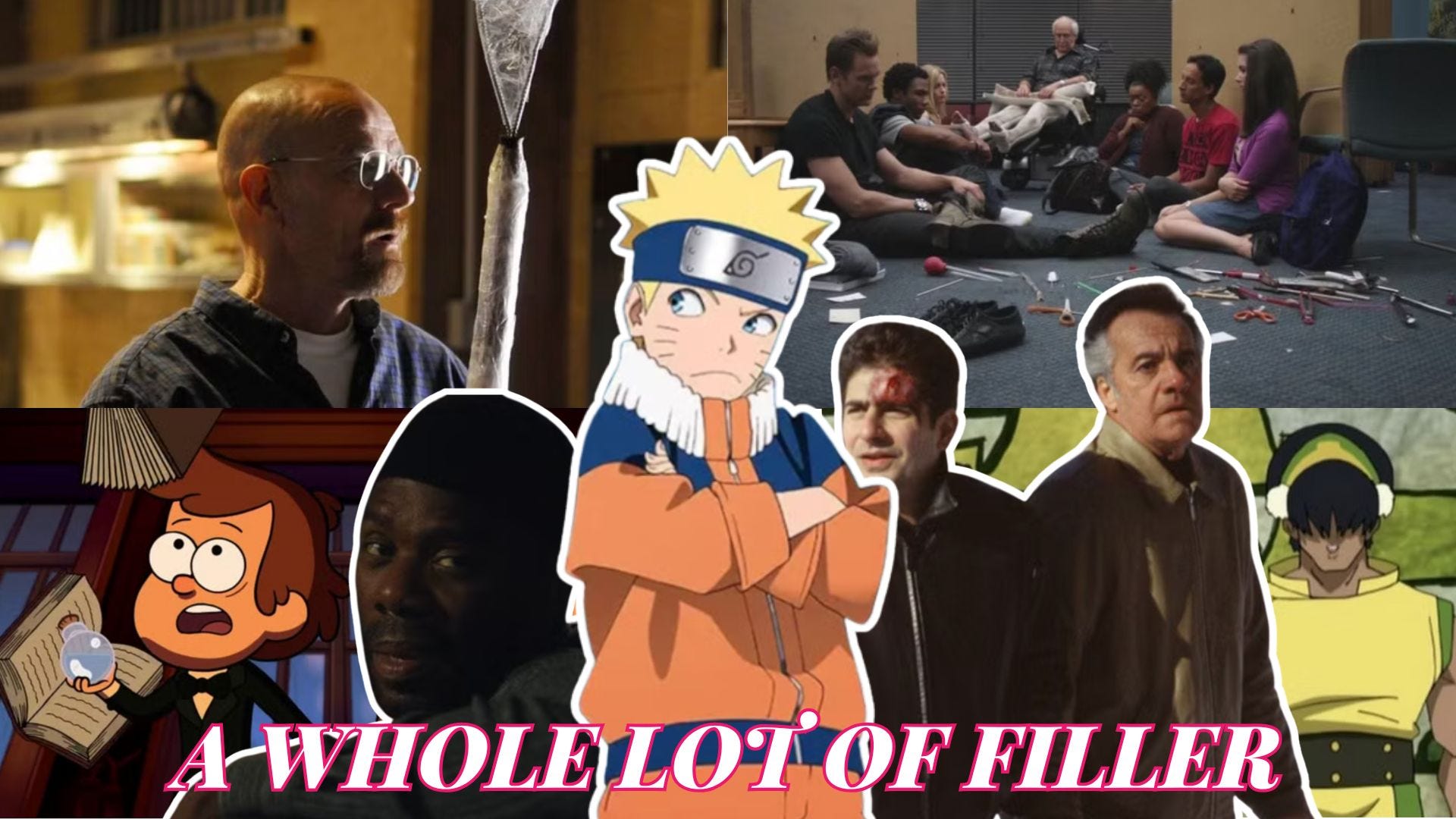
It reminds me of the “filler episode.” A lot of times, we complain about them, especially when we’re so close to that season finale, and randomly, Team Avatar decides to go see a play. But I think the filler episode is a lost art. The point is not to move the plot forward. It is about taking time to enjoy yourself and have fun consuming the content. You learn so much about the characters in these breaks from the main action. We need to get back to this. Filler episodes where characters get to have fun and forget that they’re the “Chosen One” sent to save the world. Long YouTube essays about the Kendrick and Drake beef timeline, starting back in the early days of Hip Hop culture. Books with unreliable narrators that can be quite confusing and hard to tackle, but you enjoy them because the protagonist is complex, and the writing is just that good.
I have to thank Bret Easton Ellis and Patrick Bateman. They helped me realize that I cannot read the same way I used to, but they also taught me that it’s okay. I will move at my own pace. I will sit down with the book, and I will think to myself: Is Bateman going to kill someone today? Is he going to go to the gym? Is he going to say something racist, homophobic, or misogynistic? Yes. 100%. Without a doubt, he will. Is he hallucinating in this interaction? Did he actually just say that to the bartender? But instead of being frustrated that I cannot answer the question, I will come to my own conclusion. I will read and reread, if necessary, and I will draw a conclusion for the day.
And hopefully, by the time I finish the next 250 pages, I will have a definitive answer. And even if I don’t, no problem. I can see what SparkNotes has to say. I can read the Goodreads reviews. I can watch a YouTube video. Hell, maybe I even hop on Reddit and see what those weirdos think. But at least I know it’s not that serious. It’s a fictional serial killer. It’s a commentary. It’s from the 90s. It’s retraining my brain. It’s reading for my enjoyment. Whether I understand it the way it was meant to be understood or not isn’t the point. I read the book. I made it through. I finished it. And maybe I get there and I write a review. Either way, it’s one book down, and I cannot be fazed by my inability to read when I have 9 more books to finish this year.
Peter Dinklage was also an alumnus. I always knew there was something off about him… J.K.; he’s chill. For now. But maybe we should keep him away from writing just to be safe.
This reminds me of Chapter 11 in The Picture of Dorian Gray by Oscar Wilde. Dorian becomes influenced by a book, and we get some of the most in-depth descriptions of how it changes his way of living. From collecting musical instruments, and trying different religions, to studying perfumes. It is the longest chapter in the book and does nothing to move the plot forward… or does it?
Currently, that show is Watson on Paramount+. Doctors, “detectives,” Morris Chestnut, and only one British person?… I love TV.